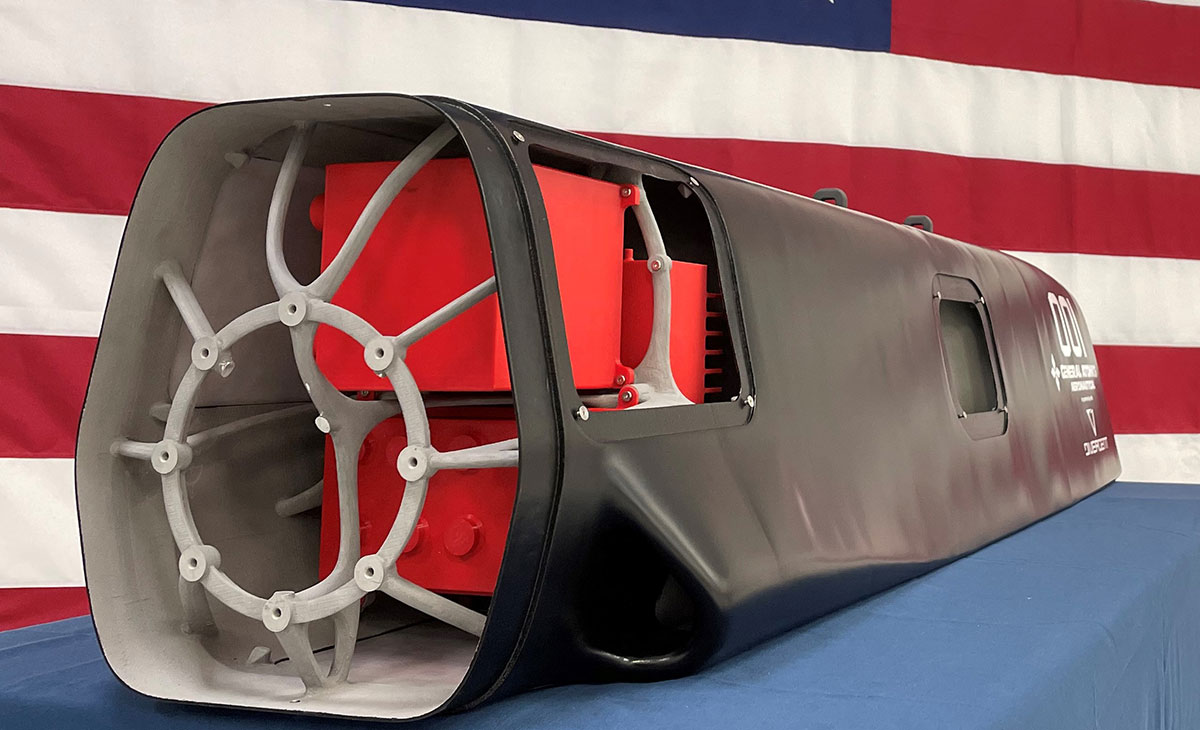
When The GOTHAAM Project Called, GA-ASI Answered
Accelerating Advanced Manufacturing Technologies for the Defense Industry
ADDITIVE MANUFACTURING BRINGS STRATEGIC VALUE TO THE DEFENSE INDUSTRIAL BASE
Many people may not realize the desktop 3D printer they use to make figurines, drawer handles, and chip clips isn’t too different from the new wave of advanced defense manufacturing.
Additive manufacturing is high-end 3D printing in a large format — the process of producing an object from a digital 3D model by precisely adding layer upon layer of material, one at a time.
General Atomics recognized long ago that advanced manufacturing technologies enable rapid production, complex geometries, materials engineered for extreme environments, reduced waste, affordability and enhanced supply chain resilience — all critical to next‑generation platform development and defense sustainment. Meanwhile, the Department of War Manufacturing Technology Program, known as DOW ManTech, began accelerating advanced manufacturing technologies and investing in high-tech solutions needed to outpace threats.
National and economic security relies on a robust industrial base armed with the advanced manufacturing technologies needed to deliver critical products and systems rapidly and affordably.
OSW ManTech
The Office of the Secretary of War Manufacturing Technology Program, or OSW ManTech, which is responsible for overseeing the program, supports public-private partnership efforts to advance manufacturing technologies. America Makes, the DoW National Additive Manufacturing Innovation Institute, directly supports OSW ManTech’s strategic imperative to mature and deploy additive manufacturing technologies across the defense industrial base.
So when America Makes put out a call for a Generation Of Technical-data for High-strength Aluminum Alloy Material – or GOTHAAM – seeking projects targeting the qualification of a high-strength aluminum alloy using laser powder bed fusion systems, GA-ASI understood the assignment -- and immediately answered.
Laser powder bed fusion, or LPBF, is an additive manufacturing process in which a high-power beam melts and fuses layers of metal powder particles together. The project will establish a qualification framework allowing the defense industrial base to adopt the technology with confidence, providing a strong return on investment for builders as LPBF aluminum alloy makes its way into the production of defense equipment.
The GOTHAAM project directly aligns with one of General Atomics’ core areas of expertise and its ongoing technology roadmap for next-generation uncrewed aerial systems, or UAS. General Atomics’ expertise in this additive manufacturing process has enabled it to rapidly deliver scalable, cost-effective uncrewed combat aircraft systems for the U.S. Air Force Collaborative Combat Aircraft program.
Additive manufacturing enables a more agile, adaptable and aligned defense supply base to outpace adversarial threats.
DoW Vision for Additive Manufacturing
THE AWARD
America Makes and the National Center for Defense Manufacturing and Machining selected General Atomics Aeronautical Systems as the winner of the GOTHAAM project call, worth $5.5 million.
“GA-ASI welcomes these opportunities to collaborate with government and industry to advance critical capabilities,” said David R. Alexander, president of GA-ASI. “We appreciate the trust America Makes has in us to lead GOTHAAM and look forward to working with the great team of partners on the project.”
Project partners include a blended team of aerospace vendors, digital engineering specialists, metal additive manufacturing and 3D printing technology providers, and upstream material producers. The lead is responsible for the project and subcontract performance.
THE PROJECT
The goal is for GOTHAAM to develop material for a high-strength, 7075-equivalent aluminum alloy across three classes of laser powder bed fusion machine systems — small, medium, and large-format printers — for scalable production. Engineers will verify that their high-strength, 7075-equivalent aluminum alloy can support long-life, high-strength structural applications.
Over 23 months, the project will progress through two phases:
- Phase 0: produce a process control document and preliminary qualification dataset that establishes baseline feedstock, process, and material requirements to enable qualification
- Phase 1: generate material compliant with the Metallic Materials Properties Development and Standardization handbook by testing across small, medium, and large multi-laser LPBF machines to confirm scalable performance and machine-to-machine equivalency for defense use.
The validated material allowables datasets will be entered in the Department of War Workbench for Additive Materials, ensuring the metal additive manufacturing data properties are accessible across the defense community. Qualifying a corrosion-resistant, aerospace-grade alloy with broad defense and commercial applications provides the defense industrial base with qualified materials for low-risk production into critical defense platforms.
THE CENTER OF EXCELLENCE
GA-ASI has invested in additive manufacturing technologies since the early 2000s, establishing the Additive Design and Manufacturing Center of Excellence in 2022. Led by Technical Director Steve Fournier, AD&M has quickly grown into an accomplished team of engineers and technicians with extensive expertise in polymers, composites, materials, and metallic AM technologies. A strong technology roadmap and qualification framework have enabled the expansion of additive manufacturing across multiple GA-ASI aircraft systems.
Printing because we should and not because we can
GA-ASI guiding principle for leveraging the benefits of additive manufacturing company wide.
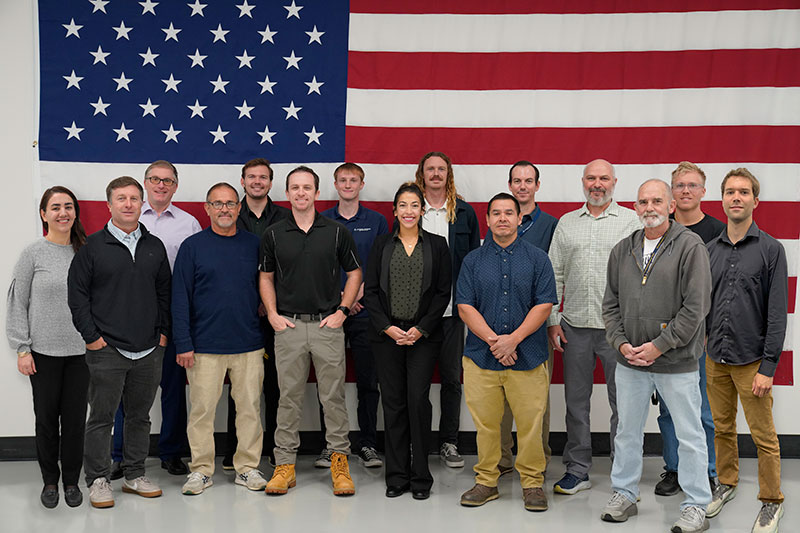
“Working closely with our colleagues across all production stages, we continually look for ways to leverage additive manufacturing technologies into the design and operation of our aircraft and payload systems.” said Fournier. By analyzing how GA-ASI system designs and manufacturing processes can benefit from applying AM methodologies, the AD&M team is constantly uncovering new ways to increase efficiency and flexibility. Internal collaboration is a key driver for the weight and performance-optimized designs of GA-ASI systems.
Advancing additive manufacturing capabilities doesn’t happen in a vacuum, though. The Additive Design & Manufacturing team actively pursues opportunities – just like the GOTHAAM project – to work alongside aerospace peers, the AM industry, and suppliers. Through its expertise and insights, the team aims to help develop and mature AM capabilities that accelerate the delivery of innovative technologies for national security and enhance manufacturing competitiveness.